
Why Seek Self-Awareness – Unlocking Flow and Healing

Trying to pin down self-awareness often leads to confusion, despite how simple it sounds on the surface. For creative entrepreneurs and high-achievers juggling multiple priorities, understanding the true depth of self-awareness is a game-changer for personal growth and emotional balance. This article pulls apart the real meaning of self-awareness, reveals common misconceptions, and sets the stage for building the clarity and alignment needed for authentic fulfillment.
Table of Contents
Key Takeaways
Point | Details |
Self-awareness is an active process | It involves real-time recognition and understanding of one’s thoughts, emotions, and behaviors, rather than mere self-analysis or accumulation of facts. |
Types of self-awareness vary | Different forms such as reflective and emotional awareness serve unique functions, and developing all types is crucial for personal growth. |
Misconceptions can hinder growth | Common false beliefs around self-awareness can lead to excessive rumination or diminished clarity, highlighting the need for structured practice. |
Practice is essential for lasting awareness | Consistent methods such as mindfulness and journaling are vital to cultivate self-awareness, ensuring it integrates with daily life effectively. |
Self-awareness Defined and Common Misconceptions
Self-awareness sounds straightforward, but the term carries multiple meanings depending on context and perspective. This confusion explains why so many people think they understand self-awareness when they actually grasp only one narrow slice of it.
Self-awareness is fundamentally a reflective internal process—the ability to recognize and understand your own thoughts, emotions, and behaviors. It goes beyond simply knowing facts about yourself. True self-awareness involves conscious recognition of how you think, why you react certain ways, and what drives your decisions in real time.
Research distinguishes self-awareness from related but different concepts:
Self-consciousness is awareness of being observed or evaluated by others; it’s social anxiety, not self-understanding
Self-knowledge is accumulated information about your personality and history; awareness is the active process of reflecting on that information
Self-reflection is thinking about yourself; awareness is understanding what that reflection reveals
The distinction matters because self-awareness involves conscious recognition of the self, while these other concepts serve different psychological functions entirely.
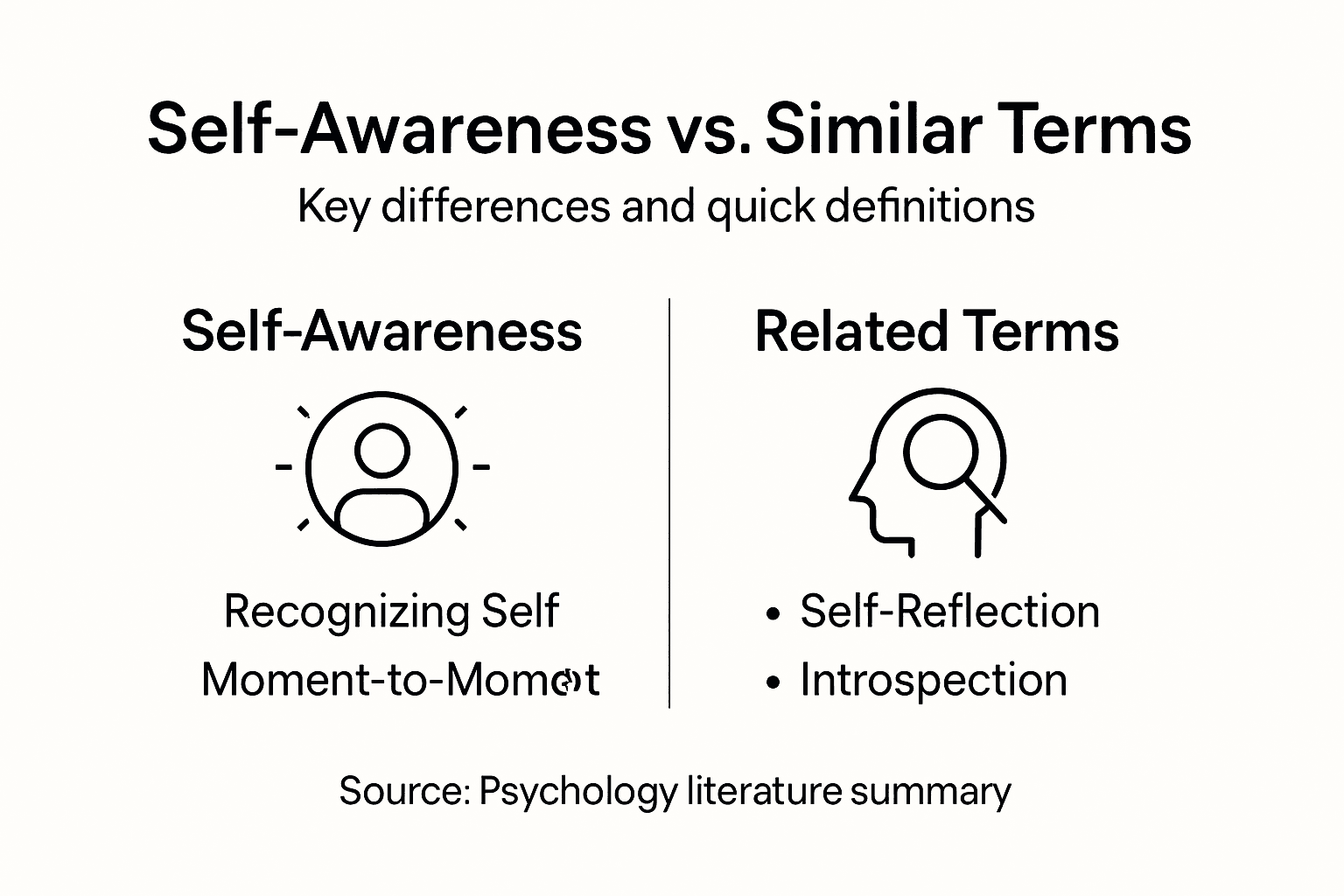
To clarify frequently confused concepts, here is a comparison of related forms of self-understanding:
Concept | Primary Focus | How It Differs From Self-Awareness | Example in Daily Life |
Self-awareness | Conscious real-time reflection | Involves active inner observation | Noticing frustration as it arises |
Self-consciousness | Concern with others’ perceptions | About social judgment, not self-clarity | Feeling anxious in a group setting |
Self-knowledge | Accumulated personal information | Facts and traits rather than process | Knowing your job history |
Self-reflection | Thinking about oneself retrospectively | Lacks immediate, real-time awareness | Journaling about a past argument |
Common misconceptions trip up even well-intentioned seekers:
Misconception 1: Self-awareness means analyzing yourself constantly. Actually, constant self-analysis often creates paralysis and anxiety rather than clarity. True awareness is calm observation, not obsessive examination.
Misconception 2: Self-awareness is a fixed destination. It’s not. Self-awareness as a psychological construct changes based on context, relationships, and life circumstances. You develop it continuously, not achieve it once.
Misconception 3: Knowing your personality type equals self-awareness. Personality assessments describe patterns, not awareness. You can know your Myers-Briggs type without understanding why you unconsciously sabotage relationships or avoid certain challenges.
Misconception 4: Self-awareness is purely psychological. It actually includes biological, interpersonal, and intrapsychic dimensions. Your nervous system state, your relationships, and your internal dialogue all shape awareness simultaneously.
Pro tip: Start observing your emotional reactions without judgment before analyzing their causes. Notice the feeling first, understand the pattern later—this builds sustainable awareness rather than exhausting overthinking.
Types of Self-Awareness and Energetic Alignment
Self-awareness isn’t monolithic. It shows up in different forms depending on what part of yourself you’re tuning into and how consciously you’re observing it.
Research identifies several distinct types of self-awareness that operate simultaneously:
Reflective self-awareness is deliberate, conscious examination of your thoughts and motivations
Pre-reflective self-awareness is implicit knowing—your body recognizing danger before your mind catches up
Somatic awareness is attunement to internal bodily signals, sensations, and your nervous system state
Emotional awareness is recognizing and naming feelings as they arise in real time
Social self-awareness is understanding how you’re perceived and how your behavior affects others
Varied types of self-awareness relate to how individuals attune to internal states and their social environments. Each type serves a different function, and high performers cultivate all of them.
Energetic alignment bridges these types. It’s the coherence between what you think, feel, and do. When your thoughts align with your emotions and your actions match both, you experience flow. When they conflict, you feel friction and depletion.
Think of it this way: Your mind might tell you a deadline is manageable while your body screams stress signals. That misalignment creates internal noise. Energetic alignment quiets that noise.
Self-connection comprises three critical components working together:
Awareness of your current state—thoughts, emotions, sensations, beliefs
Acceptance of what you notice without judgment or resistance
Alignment of your behaviors with what you’ve discovered about yourself
Without acceptance, awareness becomes self-criticism. Without alignment, awareness stays intellectual. All three must work together.
Alignment harmonizes thoughts, emotions, and behaviors, creating congruence between your internal state and external actions. This congruence is essential for mental health and sustainable personal growth.
For creative entrepreneurs and high-achievers, energetic alignment solves a common problem: burnout from misalignment. You pursue goals that don’t match your values. You perform tasks your body resists. You push through fatigue instead of listening to it. Energetic alignment restores the connection between what you want and how you operate.
Practicing meditation for self-awareness clarity helps you develop all these awareness types simultaneously while deepening energetic alignment naturally.
Pro tip: Pause three times daily and ask yourself: What am I thinking right now? What am I feeling? What is my body telling me? This simple scan develops all awareness types while revealing alignment gaps before they create problems.
Emotional Well-Being and Flow State Benefits
Flow isn’t just a productivity hack. It’s a gateway to genuine emotional healing and sustained well-being that transforms how you experience your life.

When you enter flow, something shifts neurologically. Your brain quiets the constant self-referential chatter—that inner critic evaluating whether you’re doing enough, being enough, succeeding enough. Flow states reduce self-referential thinking, creating space for genuine calm and presence.
This neural shift produces measurable emotional benefits:
Increased positive emotions that linger beyond the flow state itself
Reduced anxiety as your nervous system downshifts from threat mode
Enhanced life satisfaction from intrinsic motivation rather than external pressure
Greater emotional resilience when facing challenges outside flow
Improved emotion regulation through practiced neural pathways
Flow shares surprising similarities with meditation. Both quiet the default mode network—the brain region responsible for rumination and anxiety. Both create states of nondual awareness where the boundary between self and activity dissolves.
For high-achievers especially, this matters. You’ve built success through mental effort and willpower. Flow offers something different: ease within challenge. You’re fully engaged without straining. Your nervous system relaxes while your mind sharpens.
Flow experiences mediate the relationship between mindfulness and engagement, contributing directly to emotional well-being by promoting positive emotions and reducing anxiety. This isn’t accidental—it’s neurobiological.
The healing happens through consistent practice. One flow session reduces stress temporarily. Regular flow practice rewires your baseline emotional state. Your system learns that engagement and calm can coexist.
Flow facilitates intrinsic motivation and resilience, the two foundations of sustainable emotional health. When you’re motivated from within rather than driven by external validation, your well-being becomes self-sustaining.
Creative entrepreneurs benefit particularly because flow addresses creative burnout at its root. You stop treating productivity as punishment and start experiencing it as joy. Your work becomes nourishing rather than depleting.
A daily meditation routine trains your nervous system to access these calm-yet-engaged states more readily, preparing your brain for flow and deepening emotional well-being over time.
Pro tip: Track your emotional state before and after flow activities for two weeks. Notice how your baseline anxiety and mood shift. This data becomes your personal proof that flow healing is real and worth protecting time for.
Practices for Building Lasting Self-Awareness
Self-awareness isn’t passive. It requires deliberate, consistent practice. Without structured approaches, you’ll slip back into old patterns within weeks.
Research identifies proven practices that create lasting change across cultures and contexts:
Mindfulness meditation trains your brain to notice thoughts and emotions without judgment
Reflective journaling externalizes internal patterns, making them visible and workable
Constructive feedback reveals blind spots your self-perception can’t access alone
Coaching and mentoring provides accountability and guidance through difficult terrain
Emotional regulation techniques like cognitive reappraisal help you respond rather than react
Sustained self-awareness develops through mindfulness, reflection, feedback, and coaching. These aren’t optional add-ons; they’re the foundation.
Mindfulness forms the core. It’s the practice of noticing your internal experience without trying to change it. You observe thoughts arising and passing. You feel emotions without suppressing or amplifying them. This creates the space between stimulus and response where genuine choice lives.
Guided reflection and journaling deepen what mindfulness reveals. Writing forces specificity. Instead of “I’m anxious,” you write: “I felt anxiety spike when my colleague questioned my approach. I noticed defensiveness rising. My shoulders tensed.” That specificity is where insight happens.
Deliberate ongoing efforts including journaling, reflection, and emotional regulation strategies improve decision-making and emotional well-being while aligning actions with deeper values. This isn’t busywork; it directly shapes your life quality.
Feedback accelerates awareness by showing you what you can’t see. Your impact on others, your blind spots, your unconscious patterns—these become visible through trusted feedback from people who know you well.
Consistency matters more than intensity. Twenty minutes of daily practice outperforms sporadic deep dives. Your nervous system learns new patterns through repetition, not heroic single sessions.
For creative entrepreneurs, this consistency is particularly challenging. You’re driven by novelty and intensity. Build self-awareness practice into your non-negotiable daily structure, like exercise or sleep.
Here is a summary of strategies for sustainable self-awareness and their unique benefits:
Practice Type | Key Benefit | Best For |
Mindfulness meditation | Builds present-moment awareness | Stress-prone individuals |
Reflective journaling | Reveals internal patterns | Clarity seekers |
Constructive feedback | Identifies blind spots | Social learners |
Coaching or mentoring | Provides structured guidance | Those needing accountability |
Emotional regulation | Turns insight into action | Managing strong feelings |
Pro tip: Combine three practices: ten minutes of morning meditation, five minutes of evening journaling about one interaction or emotion, and monthly feedback conversations with one trusted person. This triad covers awareness, integration, and reality-checking simultaneously.
Risks, Challenges, and What to Avoid
Self-awareness is powerful, but without proper guardrails, it can become harmful. The same introspective practices that heal can wound if misapplied.
The primary risk is excessive rumination. Spending hours analyzing your thoughts and emotions doesn’t deepen awareness—it amplifies anxiety and depression. Excessive rumination or negative self-focus can exacerbate anxiety or depression, especially without professional support or balanced approaches.
Rumination differs from reflection. Reflection asks: “What happened and what can I learn?” Rumination asks: “Why am I like this? What’s wrong with me? Will this ever change?” The second path spirals downward.
Other significant challenges to navigate:
Psychological resistance to uncomfortable truths about yourself
Cognitive overload when processing complex emotions or patterns simultaneously
Privacy risks if sharing personal insights on digital platforms unsafely
Misapplication of practices leading to deeper confusion rather than clarity
Loss of motivation when progress feels slow or invisible
Challenges include psychological resistance and maintaining motivation in learning contexts. Your mind naturally resists awareness of painful truths. You’ll find reasons to skip practice. You’ll convince yourself you don’t have time.
Another trap is false intimacy with strangers online. Sharing vulnerable reflections in public forums or social media creates the feeling of connection while actually increasing exposure and vulnerability without reciprocal support.
Misunderstanding reflective practices causes damage too. Some people use journaling as extended self-criticism, reinforcing negative beliefs rather than examining them neutrally. Others overthink every emotion, turning natural feelings into diagnostic problems.
Effective self-awareness development requires supportive environments, guidance, and integration with broader personal or therapeutic goals. Solo practice without structure can backfire.
For creative entrepreneurs especially, the temptation exists to turn self-awareness into another performance metric. You track patterns obsessively, judge yourself against imaginary standards, and paradoxically become less aware through excessive analysis.
Your nervous system also matters. If you practice reflection while already dysregulated, you’ll amplify distress. Grounding and stabilization should precede deep reflection.
The solution isn’t avoiding self-awareness. It’s practicing with structure, balance, and support. Set time limits on reflection. Pair introspection with somatic practices that regulate your nervous system. Work with a coach or therapist, especially when uncovering trauma or deeply rooted patterns.
Pro tip: If you notice rumination or increased anxiety after practice sessions, immediately stop and do something grounding—walk outside, stretch, talk with someone. Self-awareness done without body awareness becomes psychological harm disguised as growth.
Unlock True Self-Awareness and Flow with Guided Energy Alignment
The journey to authentic self-awareness often feels overwhelming, filled with challenges like rumination, emotional resistance, and misalignment between thoughts, feelings, and actions. If you find yourself struggling to pause the inner critic or seeking calm observation instead of anxious overanalysis, you are not alone. This article highlighted the critical role of energetic alignment in harmonizing your mind, body, and emotions to unlock flow and emotional well-being. Imagine transforming the exhaustion of misaligned goals into the ease of creative flow rooted in deeper clarity and acceptance.
Take the next step toward lasting clarity and emotional healing with the 30-day guided meditation and energy alignment program at Awaken Flow Mastery. Our practice combines meditation, intuitive journaling, and sound frequencies to build sustainable self-awareness and align your energetic field with your higher self naturally and effortlessly. Don’t let burnout or excessive rumination hold you back. Experience how structured mindfulness and integration create profound flow states that reduce anxiety and increase emotional resilience. Start your transformation today and access a proven path to flow, healing, and personal growth at Awaken Flow Mastery. Your journey to energetic harmony and self-connection begins now—embrace it with confidence at Awaken Flow Mastery.
Frequently Asked Questions
What is self-awareness and why is it important?
Self-awareness is the ability to recognize and understand your own thoughts, emotions, and behaviors. It is essential because it helps you make informed decisions, improve your relationships, and achieve personal growth.
How can self-awareness lead to a flow state?
Self-awareness facilitates a state of flow by aligning your thoughts, emotions, and actions. When you are in tune with your internal states, you can engage fully in tasks, reducing distractions and enhancing productivity.
What are some effective practices to build self-awareness?
Effective practices for building self-awareness include mindfulness meditation, reflective journaling, seeking constructive feedback, and engaging in coaching or mentoring. These methods promote ongoing self-reflection and understanding of your internal patterns.
What risks are associated with seeking self-awareness?
Risks of seeking self-awareness include excessive rumination, psychological resistance to uncomfortable truths, and cognitive overload. These issues can lead to increased anxiety or confusion if not approached mindfully and with proper support.
Recommended

Comments