
Meditation's role in productivity: 2026 professional guide

Meditation isn’t just about calm—it’s about rewiring how your brain processes information. Research shows that long-term meditation enhances attention regulation, the cornerstone of workplace productivity. Yet many professionals dismiss meditation as too passive or time-consuming for their demanding schedules. This guide cuts through misconceptions, examining scientific evidence for meditation’s impact on work performance and offering practical strategies tailored for busy professionals seeking genuine productivity gains through mindfulness and energy alignment.
Table of Contents
Key takeaways
Point | Details |
Attention regulation | Meditation strengthens executive and sustained attention, directly improving task performance and focus at work. |
Mindfulness practice | Intentional present-moment awareness reduces stress and enhances emotional regulation, removing productivity barriers. |
Research validation | Meta-analyses confirm mindfulness programs improve work performance, though study quality varies significantly. |
State vs trait effects | Short-term benefits appear quickly, but lasting cognitive improvements require consistent long-term practice. |
Practical application | Daily meditation routines, even brief sessions, can deliver measurable productivity gains when applied consistently. |
How meditation improves attention and focus
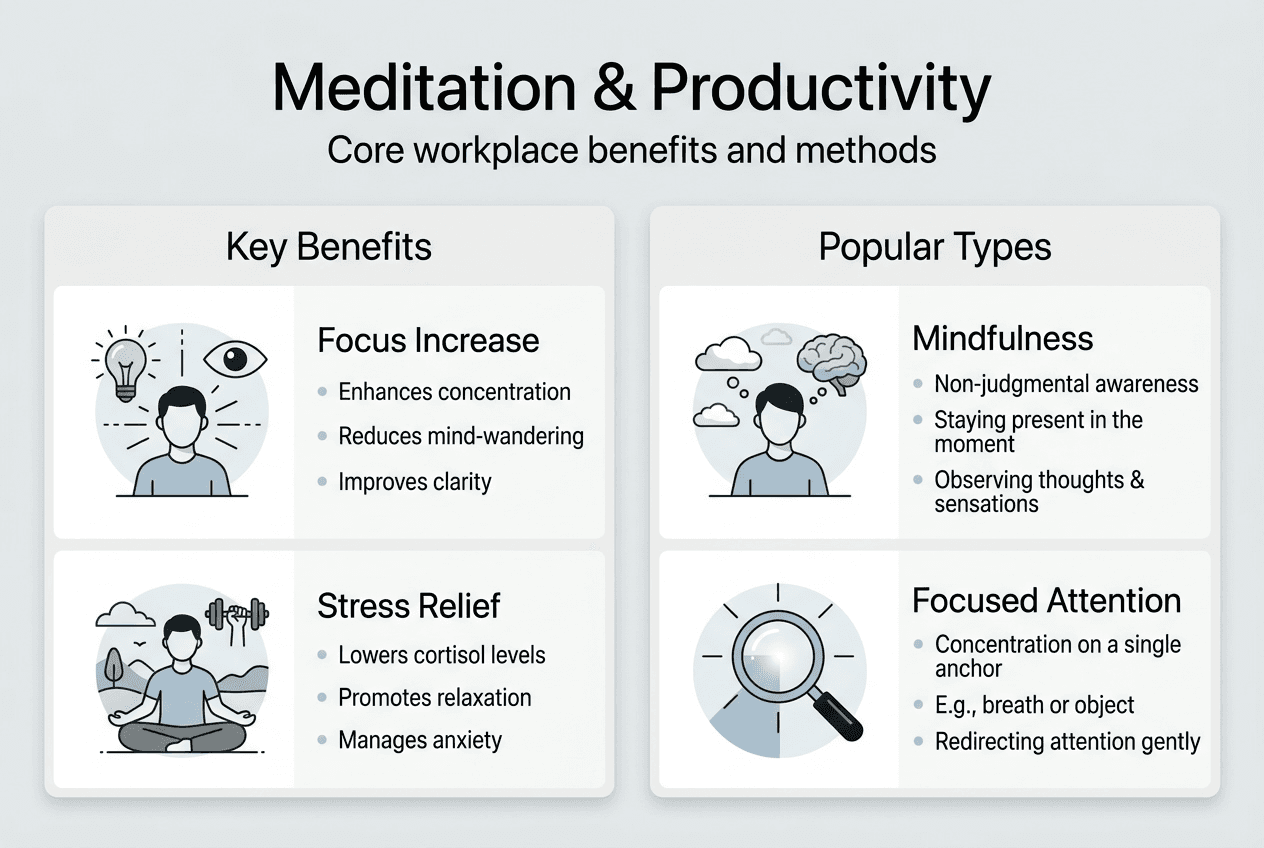
Your ability to sustain attention determines how effectively you complete complex work tasks. Meditation trains this exact cognitive skill by requiring practitioners to maintain focus on a single object—breath, mantra, or body sensation—while gently redirecting wandering thoughts. This repeated mental exercise strengthens neural pathways responsible for executive attention, the brain function that filters distractions and prioritizes relevant information.
Studies reveal that meditation enhances attention regulation through measurable changes in brain activity. Long-term practitioners show improved performance on tasks requiring sustained focus and reduced attentional blink, the brief period when your brain fails to process new information after identifying a target. Faster information processing means you can handle multiple work demands more efficiently without mental fatigue.
These cognitive improvements translate directly into workplace benefits:
Enhanced ability to maintain focus during lengthy meetings or detailed analysis
Reduced mental fatigue when switching between different project requirements
Improved accuracy on tasks requiring careful attention to detail
Better emotional regulation when facing stressful deadlines or conflicts
The mechanism behind these gains centers on mindfulness—intentional, nonjudgmental awareness of present-moment experience. When you practice guided meditation, you’re essentially training your brain to recognize when attention drifts and consciously redirect it. This skill transfers seamlessly to work environments where distractions constantly compete for mental resources.
“Attention is not just about focusing harder—it’s about developing the metacognitive awareness to notice when you’ve lost focus and the skill to bring it back without self-judgment.”
Executive attention functions like a mental spotlight, illuminating what matters while dimming background noise. Meditation strengthens this spotlight’s intensity and your control over where it points. Professionals who develop this capacity find themselves naturally more productive, not through working longer hours but through working with sharper mental clarity and reduced cognitive waste.
Mindfulness meditation: Definition, benefits, and workplace impact
Mindfulness meditation involves deliberately paying attention to present-moment experience without judgment or reactivity. Unlike concentration practices that narrow focus to a single point, mindfulness cultivates open awareness—noticing thoughts, emotions, and sensations as they arise while maintaining equanimity. This distinction matters because workplace productivity requires both focused attention and flexible awareness to navigate shifting priorities.

The practice directly addresses stress, one of productivity’s biggest enemies. When you’re stressed, your prefrontal cortex—responsible for rational decision-making and planning—becomes compromised as your amygdala triggers fight-or-flight responses. Mindfulness meditation reduces stress by training you to observe stressful thoughts without automatically reacting to them, creating space between stimulus and response.
Systematic reviews demonstrate that mindfulness programs improve work performance across multiple dimensions. Participants in randomized controlled trials showed improvements in task completion, decision quality, interpersonal communication, and overall job satisfaction. These gains stem from enhanced emotional regulation, allowing professionals to maintain composure during high-pressure situations and make clearer judgments.
Integrating mindfulness into daily routines delivers measurable productivity benefits:
Morning sessions set intentional focus for the day ahead
Brief midday practices reset attention when mental fatigue accumulates
Evening meditation supports better sleep quality, enhancing next-day performance
Consistent practice builds resilience against workplace stress and burnout
The key to success lies in consistency rather than duration. Ten minutes of daily mindfulness practice produces more sustainable benefits than sporadic hour-long sessions. Start with manageable goals—five minutes upon waking—and gradually extend as the habit solidifies. Setting clear intention before each session amplifies effectiveness by priming your mind for the specific benefits you’re cultivating.
Pro Tip: Anchor your meditation practice to an existing habit like morning coffee or lunch break. This environmental trigger makes consistency easier and embeds mindfulness naturally into your professional routine.
Challenges and considerations in meditation research on productivity
Interpreting meditation research requires understanding significant methodological variations across studies. Researchers use different meditation types, practice durations ranging from weeks to years, and diverse participant populations from complete beginners to advanced practitioners. This heterogeneity makes direct comparisons difficult and limits how confidently we can generalize findings to specific workplace contexts.
One critical distinction involves meditation states versus traits. States are temporary experiences during or immediately after practice—enhanced calm, improved focus, reduced anxiety. Traits represent lasting changes in baseline cognitive and emotional functioning that persist regardless of whether you’re actively meditating. Research shows that while states appear quickly, developing traits requires sustained long-term practice.
Several limitations affect current productivity research:
Small sample sizes reduce statistical power and reliability of findings
Self-reported measures introduce subjective bias compared to objective performance metrics
Lack of active control groups makes isolating meditation’s specific effects challenging
Publication bias favors positive results, potentially overstating benefits
Understanding these challenges helps set realistic expectations. Meditation isn’t a magic productivity pill that transforms performance overnight. It’s a gradual training process that reshapes cognitive habits through consistent practice. The most robust benefits emerge from integrating meditation with other evidence-based productivity strategies like time blocking, energy management, and strategic rest.
Research quality varies substantially. Meta-analyses combining multiple studies provide stronger evidence than individual trials, but even these face challenges when underlying studies use inconsistent methods. When evaluating meditation claims, look for systematic reviews, randomized controlled trials, and research published in peer-reviewed journals rather than anecdotal testimonials or marketing materials.
Different meditation practice types produce distinct effects. Focused attention meditation strengthens concentration, mindfulness cultivates open awareness, and loving-kindness practices enhance emotional regulation. Matching practice type to your specific productivity goals increases effectiveness. If you struggle with distractions, focused attention meditation offers more direct benefits than compassion practices.
Pro Tip: Track your meditation practice and productivity metrics separately for at least 30 days. This personal data reveals whether meditation genuinely improves your work performance or if other factors drive changes you’re experiencing.
The benefits of daily meditation accumulate gradually. Don’t expect immediate transformation—approach meditation as a long-term investment in cognitive capacity rather than a quick fix for current productivity challenges.
Practical meditation strategies to boost your productivity
Building an effective meditation practice requires matching techniques to your schedule, experience level, and specific productivity goals. The following step-by-step approach works for professionals at any meditation experience level:
Start with five minutes daily, preferably at the same time each morning to establish consistency.
Choose a quiet space where interruptions are unlikely and create a simple ritual signaling practice time.
Focus on breath awareness—notice the sensation of breathing without trying to control it.
When your mind wanders, gently return attention to breath without self-criticism or frustration.
Gradually extend duration by one minute weekly until reaching 15-20 minutes daily.
Add brief two-minute mindfulness breaks during work hours to reset focus between tasks.
Incorporate daily mindfulness practices like mindful walking or eating to extend awareness beyond formal sessions.
Different meditation approaches offer distinct productivity benefits. This comparison helps you select practices aligned with your specific needs:
Meditation Type | Primary Focus | Productivity Benefits | Best For |
Mindfulness | Present-moment awareness | Stress reduction, emotional regulation, flexible attention | Managing workplace anxiety and multitasking demands |
Focused Attention | Single-point concentration | Sustained focus, reduced distractibility, mental stamina | Deep work requiring extended concentration periods |
Energy Alignment | Connecting with inner wisdom | Enhanced motivation, clarity on priorities, sustained engagement | Professionals seeking purpose-driven productivity and personal growth |
Body Scan | Physical sensation awareness | Stress release, improved sleep, reduced tension | Combating physical fatigue and stress-related health issues |
Pro Tip: Use brief mindfulness breaks strategically during your workday. After completing a major task or before starting a new project, take 60-90 seconds to focus on breath. This micro-meditation resets attention and prevents mental fatigue from accumulating.
Energy alignment techniques add a powerful dimension to productivity meditation. By cultivating self-awareness through meditation, you develop clearer understanding of your natural energy rhythms and authentic priorities. This clarity helps you structure work around peak performance windows rather than fighting against your natural patterns.
Consistency matters more than perfection. Missing occasional sessions won’t derail progress, but abandoning practice for weeks requires rebuilding momentum. Set realistic goals based on your current schedule rather than idealized visions of hour-long daily sessions you’re unlikely to maintain.
Research confirms that long-term meditation selectively improves attentional functions directly relevant to work tasks. These aren’t abstract spiritual benefits—they’re measurable cognitive enhancements that translate into tangible productivity gains when applied consistently over months and years.
Explore flow mastery meditation programs
Ready to transform meditation knowledge into sustained productivity improvement? Awaken Flow Mastery offers structured programs specifically designed for professionals seeking to enhance focus, reduce stress, and align energy with meaningful work. Our 30-day guided meditation series combines evidence-based mindfulness techniques with energy alignment practices, helping you access flow states that maximize both productivity and personal fulfillment.

Unlike generic meditation apps, our programs integrate intuitive journaling, sound frequencies, and practical tools for embedding meditative insights into daily professional life. The flow mastery approach emphasizes experiential learning—you don’t just learn about meditation’s benefits, you directly experience cognitive shifts that enhance work performance. Unique offerings like our higher self reconnection meditation deepen personal growth alongside productivity gains, creating sustainable motivation rooted in authentic purpose rather than external pressure.
FAQ
What is the role of meditation in improving work productivity?
Meditation enhances productivity primarily by strengthening attention regulation and reducing stress. These cognitive improvements enable better focus on complex tasks, faster information processing, and more effective emotional management during workplace challenges. Consistent practice builds lasting traits that support sustained high performance.
How long does it take to see productivity benefits from meditation?
You’ll notice immediate state benefits like improved calm and focus during or right after sessions. However, lasting trait improvements in baseline attention and stress resilience typically emerge after 8-12 weeks of consistent daily practice. Long-term practitioners continuing for months or years experience the most substantial cognitive enhancements.
Can meditation help reduce workplace stress to improve productivity?
Yes, mindfulness meditation significantly reduces stress by training you to observe thoughts and emotions without automatic reactivity. Lower stress levels directly improve decision-making quality, interpersonal communication, and task performance. This stress reduction removes a major barrier to productive work, allowing your cognitive resources to focus on meaningful tasks rather than managing anxiety.
What types of meditation are best for boosting productivity?
Mindfulness and focused attention meditations have the strongest research support for productivity enhancement. Mindfulness develops flexible awareness and stress resilience, while focused attention strengthens sustained concentration. Energy alignment techniques complement these practices by clarifying authentic priorities and sustaining motivation through purpose-driven work rather than willpower alone.
Recommended

Comments